

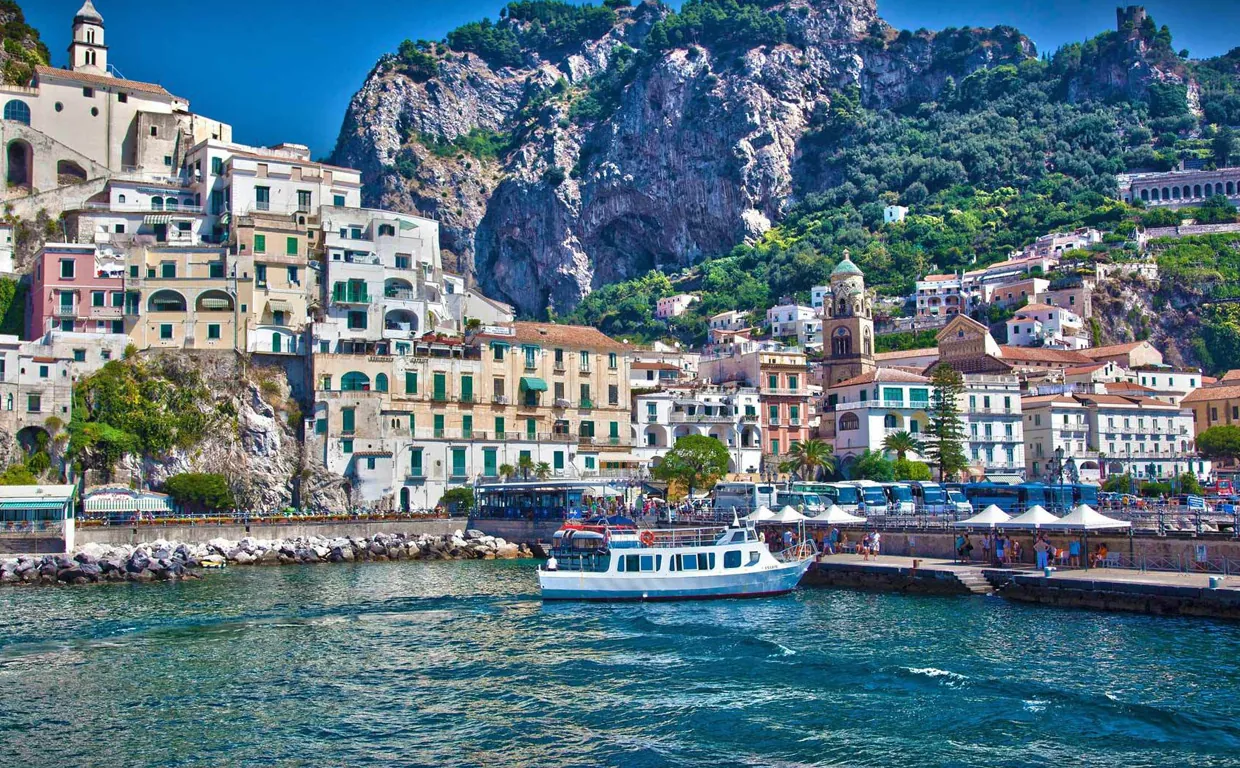
Amalfi
The town that gives its name to the whole coast.
It is the town that gives its name to the whole coast and one of the best-known tourist destinations in the world, for its thousand-year history, the importance of its monuments and the splendid natural setting that has earned it a place on the UNESCO World Heritage list.
The town's coat of arms reads "Descendit ex patribus Romanorum" and indeed the origins of Amalfi seem to go back to Roman times, as shown by the discovery of a nymphaeum belonging to a villa probably built in the time of Emperor Tiberius. The name too has Latin origins and would derive either from Melfi, a town in Lucania whose refugees landed on the Amalfi coast and founded the town, or from the "gens Amarfia".
Already a bishopric in 596, it was part of the Romano-Byzantine duchy until 839, when it became an autonomous republic (the first of the Maritime Republics of Italy), governed first by yearly elected Counts, then by Prefects and finally by Dukes who turned it into a sort of ducal monarchy. From then on began Amalfi's supremacy in trade with the East and, in general, in managing commerce across the whole Mediterranean, through a dense network of settlements in the main ports. Amalfi's merchant ships, loaded with timber, sailed to the coasts of North Africa, Syria, Palestine and Byzantium, exchanging it for gold, spices, precious stones and fabrics. Amalfi's merchants soon became very rich, so much so that they attracted the attention and enmity of new and emerging rivals such as Pisa and Genoa.
Of Amalfi's maritime history there remain the masonry shipyards, used to build the hulls of fighting galleys, the maritime code called the "Tabula de Amalpha" and the tradition that the compass was invented by Flavio Gioia.
Conquered by the Normans in 1131 and sacked by Pisan troops a few years later, Amalfi lost its autonomy even though, economically, enterprise focused on the production of paper using the Arab method and on ironwork and wool. The decline coincided with the war between Angevins and Aragonese and, in particular, with a terrible storm that, in the night between 24 and 25 November 1343, swallowed up much of the city's ancient port. Turned into a fiefdom, it was ruled by various families: Sanseverino, Colonna, Orsini and Piccolomini.
Amalfi's tourist history begins with the arrival of Northern European travellers in the age of the Grand Tour when, at the end of the 18th century, they set out in search of traces of the past and romantic views. From then on Amalfi and, in general, the coast were rediscovered also by famous people as a place to spend their holidays.
Places of interest
- The whole urban layout of Amalfi which, especially in the historic centre, has kept its medieval look intact, with its gates (Porta Marina, Porta Occidentale, Porta Hospitalis), narrow paved lanes, covered passages, alleys and steps leading to wide squares overlooked by fine medieval palaces and old noble chapels.
- The many watchtowers (Torre di Vettica, Torre San Francesco or Saracena, Torre dello Ziro), part of the defensive system designed in the viceregal era to protect coastal people from pirate attacks.
- The remains of the tower and castle of Pogerola (the ancient Pigellula).
- The ancient arsenals of the Maritime Republic, of which only two aisles divided by ten pillars survive today, used to build warships. It is the only example of a medieval arsenal in Southern Italy.
- The Cathedral of Sant'Andrea, reached by a spectacular staircase, dominates Piazza Duomo. The original Romanesque structure is now clothed in sumptuous Baroque. Built in 987 by Mansone I, Duke of Amalfi, it has a basilica plan with transept and apse. The polychrome façade is dominated by the tympanum mosaic by Domenico Morelli. Inside are a coffered ceiling, 18th-century canvases, a 13th-century wooden crucifix, a mother-of-pearl cross from Jerusalem and a porphyry font from a Roman villa. The crypt holds the relics of Saint Andrew, from which, since 1304, a dew called manna has flowed. The bronze doors were made in Constantinople for the rich Amalfi merchant Pantaleone de Comite.
- The Basilica of the Crucifix, next to the Duomo, from the 9th century, built on an earlier early-Christian building. Three naves with a matroneum; today it houses the Museum of Sacred Art of the Duomo.
- The Cloister of Paradise, built by Archbishop Filippo Augustariccio in 1268 as a cemetery for Amalfi nobles: a quadriporticus of interlaced pointed arches typical of Arab-Norman architecture, on slender paired columns, with six chapels and a fresco attributed to the Neapolitan school of Giotto.
- The Bell Tower, Romanesque, built between 1180 and 1276, with a Moorish bell chamber covered in green and yellow majolica tiles.
- The Benedictine convent of the Santissima Trinità, from the 16th century, now Palazzo San Benedetto, seat of the Post Office, Town Hall offices and the Library. The ceramic panel by Diodoro Cossa (1968) at the entrance shows the highlights of Amalfi's history.
- The former Monastery of San Basilio, from the 12th century, now converted into homes.
- The Baroque Church of San Benedetto, with fine 18th-century canvases.
- The Church of Sant'Anna piccola, also known as "la scura" for the dark tones used for the saint's image on the altar.
- The Chapel of Sant'Anna la Grande, on the ground floor of the 15th-century Palazzo Bonito.
- The Church of Santa Maria Maggiore, with a fine Moorish bell tower, founded by Duke Mansone I in 986; it holds the remains of San Felice, a fine 18th-century nativity scene and important canvases.
- The Church of San Biagio, documented from the 11th century, long part of the holdings of Montecassino Abbey, with a precious 18th-century ceramic floor and 16th-century paintings.
- The ancient Convent of San Francesco, now a hotel, founded in 1222 by Saint Francis of Assisi, who came to Amalfi to pray at the tomb of Saint Andrew. A Moorish-style cloister is still visible.
- The ancient Convent of the Capuchins, now a hotel, built by Pietro Capuano in 1212, with a splendid 13th-century cloister and a magnificent flowered balcony.
- The Church of the Addolorata, built in the late 18th century, with 17th–18th-century canvases, a 16th-century marble Madonna and Child, a Renaissance Pietà and a late-Gothic bas-relief. Its confraternity holds the Procession of the Battenti every Good Friday.
- The Church of Sant'Antonio da Padova, from the first half of the 13th century, with a fine 18th-century altarpiece and two marble inscriptions.
- The small Church of Santa Lucia (12th century).
- The small Chapel of San Cristoforo, protector of travellers.
- The Church of Santa Maria dell'Annunziata (1349), with precious 17th–19th-century canvases.
- The Church of Santa Maria a Piazza, also called Santa Maria di Portosalvo, where in medieval times the heart of Amalfi's commerce lay. It holds a Byzantine-style altarpiece of the Black Madonna and Child.
- The Church of Santa Maria del Pino, also called del Carmine, the private chapel of the Lupino family, built in the 15th century.
- The Chapel of San Giuseppe dei Castriota (16th century).
- The Church of Santa Maria del Carmine, with numerous wooden statues, a precious painting and a Roman cinerary urn.
- The Chapel of Santa Maria delle Grazie, in Piazza Piccolomini.
- The Chapel of Santa Maria della Neve, with a fine altar bas-relief of the Madonna and Child and the snow.
- The Church of the Madonna del Rosario, in the Valley of the Mills, from the 19th century, after the earlier building higher up was flattened by a landslide.
- The parish of Santa Marina, from the 12th century, in the hamlet of Pogerola, with a fine porch under cross vaults.
- The Church of San Michele Arcangelo, built in 1181 on a Byzantine plan, in the hamlet of Pogerola.
- The Church of the Madonna delle Grazie, built in the first half of the 16th century at the wish of some local families.
- The Church of Santa Maria, in the hamlet of Pastena, with two naves and a cross vault.
- The Church of the Nativity of the Virgin Mary, in the hamlet of Lone, a rebuilding of the original 13th-century church that collapsed.
- The Church of San Michele Arcangelo, in the hamlet of Vettica Minore, from the late Middle Ages.
- The Church of San Pietro, in the hamlet of Tovere, with important Byzantine architectural elements.
- The rock chapel of the Santissima Trinità, in the hamlet of Tovere.
- The Monumental Cemetery, a former 10th-century Benedictine monastery.
- The remains of the 13th-century cloister of the old Church of the Holy Spirit, with fine interlaced arches.
- The remains of the Church of San Bartolomeo (13th century).
- The remains of a 13th-century Arab bath.
- The ruins of the old paper mills (Nolli, Martino, Milano, Lucibello).
- The ruins of the old ironworks, from the 14th century.
- The Fountain of Sant'Andrea or del Popolo, in Piazza Duomo.
- The Fountain of the Capa di Ciuccio, so called because donkeys once drank there.
- The old Court of the Piccolomini Dukes.
- The ancient Domus Campolillo, an 11th-century aristocratic residence reworked in the 13th century.
- Palazzo Castriota, which belonged to the Castriota-Scanderbeg family of Albanian origin.
- Palazzo Piccolomini, from the 12th century, named after the noble family that ruled Amalfi from 1461.
- The so-called Lampione, the remains of an old 12th-century domus with a fine colonnaded entrance hall.
- The ceramic panel by Renato Rossi.
- The Cavaliere and Amatruda paper mills, the only ones left of the 16 that once animated the valley.
- The Civic Museum, which keeps the famous Amalfi Tables (Tabula Civitatis Malphae), the first text of maritime law, hugely influential until the 17th century. Also on show are examples of the tarì (the old Amalfi coin), old nautical instruments and works by Pietro Scoppetta.
- The Amalfi Paper Museum, in a medieval 13th-century paper mill. A guided tour shows how the renowned Amalfi paper is made.
- The Valle delle Ferriere Nature Reserve, named after the remains of medieval ironworks, in a deep valley behind Amalfi. Established in 1972, it has a special microclimate that has allowed the survival of some very rare ferns, such as Woodwardia radicans.